
We rely much more on facial expressions and body language to communicate than we often realize.
So knowing common and culturally-appropriate gestures can really help you communicate in Japan, especially when your limited vocabulary fails!
Here are 16 Japanese gestures that will help you make new friends and acquaintances, plus the ones that you shouldn’t make in case you offend someone.
Let’s get started!
Contents
Download:
This blog post is available as a convenient and portable PDF that you
can take anywhere.
Click here to get a copy. (Download)
Bowing

Bowing is absolutely integral to Japanese language and culture.
You bow to say hello, excuse me, thank you, sorry, please and just about anything else. When meeting someone for the first time and even when greeting an old friend, Japanese people usually bow rather than shaking hands or hugging.
Bowing is such an enormous part of Japanese communication that I have trouble speaking Japanese without bowing or at least ducking my head—even if it’s to another non-native speaker.
Bowing in itself doesn’t need a lot of explanation, but there’s a “right” way to bow in Japan.
1. How to bow in Japan
Men place their hands at the sides of their legs and bow from the waist, while women should place hands flat on the front of their thighs or clasp their hands in front of their legs.
Look at the ground and bend from the waist, pause for a moment, then stand up straight.
The length of time and depth of your bow is dictated by social context and stature; for example, a sales clerk will likely bow a full 90º to you as you exit their store, and won’t stand up straight until you’re out the door. This is also the typical bow that employees at a company would use when the CEO passes by.
In regular social interaction—say with a friend, teacher or an older person who smiles at you on the train platform—a slight duck of the head is probably fine.
2. Giving and receiving gifts
You should always bow when giving or receiving a gift in Japan, and you should hold the item in both hands as you pass it over or accept it.
Indicating Yes, No and Not Sure

Nodding and shaking your head are fairly universal gestures, and they’ll serve you well with Japanese speakers. There are, however, Japanese equivalents of these gestures, and it’s worth at least recognizing what they mean.
3. Yes/okay
Make a big O shape above your head with your arms to indicate “okay!” in much the same way as we might use a thumbs-up or put our first finger and thumb together (both of which are considered fairly crass gestures in Japan!).
4. No
To indicate “no” in Japanese, often people will cross their arms in an X shape front of themselves.
This was one gesture that I found a little disconcerting at first, because it seemed kind of strong and I thought I was doing something very wrong. However, I’ve since learned that it isn’t meant in a rude way and is a “no” gesture used in much the same way as shaking your head.
If someone crosses their fingers together, however, that means conflict and is intended as an insult!
Above you can see the fantastic vloggers from Texan in Tokyo demonstrating both the “yes/okay” and “no” gestures here, in an image taken from this video.
5. I don’t know/excuse me
If someone is waving one hand in front of their face, it means that they don’t know the answer to your question or they’re trying to tell you that they can’t speak English. Often they’ll also shake their head, along with a look of terror on their face!
If they’re holding up one hand in front of their face but not moving it, that means “excuse me” and they probably want to get past you.
The “I don’t know” gesture is just like this, only the person will also wave their hand in front of their face (a little like if there was a bad smell!) and probably duck their head in a small bow.
Gesturing to People

6. Referring to yourself
Refer to yourself by pointing towards or even touching the end of your nose.
7. Referring to others
Gesture towards others with an open palm, and move your hand slowly and gently—you can point towards yourself, but don’t point at others.
8. Beckoning someone
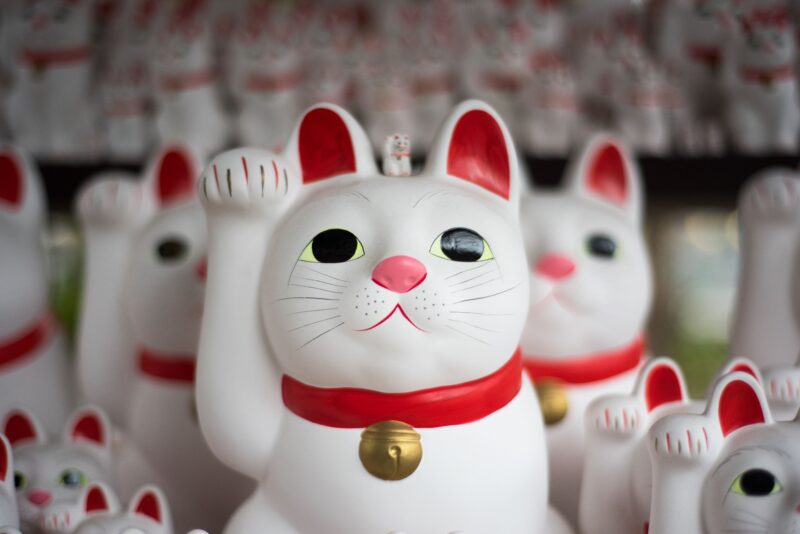
Have you ever seen a 招き猫 (まねきねこ), the lucky cat in stores?
To Westerners it looks like it’s waving goodbye, when in fact it’s beckoning you in! The Japanese way of gesturing for you to “come here” is to reach forward and let your hand go limp, then flap your fingers back and forth.
At first it may look to you like a gesture to go away, but in fact it’s an invitation to join—just don’t use it with your seniors or superiors.
Counting

9. Counting on your fingers in Japanese
The way Japanese native speakers count on their hands can be maddeningly confusing for English speakers, because it’s basically completely backwards from our style.
You hold out your open palm first and the progressively lower your fingers as you count. There will be some variation depending on the person, but this is the most common way.
It’s worth watching this YouTube video for a clear explanation and demonstration of how to count on your fingers in Japanese—which is very useful if you have trouble remembering the correct counters to use for different items!
Expressing Feelings

Besides basic body language like smiling or frowning, there are specific gestures that Japanese people use to communicate particular emotions.
10. Anger
The Japanese gesture to express anger is to hold your fists beside your head with the fingers pointing towards the sky, and is used to represent “devil horns.”
Above is an example of the gesture (though she doesn’t look so angry, does she!).
11. Embarrassment
If a Japanese person brings a hand to the back of their head, it means that they’re feeling embarrassed, or awkward, and it’s probably a good idea to change the subject!
12. Gratitude
At the end of a meal, Japanese people clap their hands once in front of their face while saying “ごちそうさま” or “ごちそうさまでした” to express gratitude.
This gesture (without the phrase) is also used to ask for forgiveness.
13. Determination
If a Japanese person wants to show that they’re ready to accept a challenge or work hard at something, they’ll place one hand on the opposite bicep and flex their arm.
This gesture expresses strength and resilience, showing that the person is prepared for whatever may be in store.
More Japanese Gestures!

14. Calling dibs
I wouldn’t do this too often lest you appear greedy, but if you lick your finger and touch a person or object, it’s all yours.
15. Indicating let’s eat/let’s drink
To suggest to a friend that you go out for a drink together, place your thumb and index finger together like you’re holding a small cup, then motion towards your mouth like you’re taking a big swig of sake.
If you would rather go for a meal, shape one hand like a bowl in front of you, then make “chopsticks” with the first two fingers of your other hand. Motion the “chopsticks” towards your mouth like you’re shoveling in some delicious noodles!
16. Making the peace sign
The ubiquitous peace sign is used of course as a standard pose for photographs in Japan, but it’s also often used as a greeting gesture, particularly for foreigners.
It expresses a sense of success, as well as being a gesture of peace and goodwill.
Gestures and Body Language to Avoid in Japan

When it comes to your own non-verbal communication, knowing what not to do can be just as important as what to do. So here are some gestures and body language that may cause offense.
Looking people in the eye too much
While in English-speaking countries looking people in the eye is considered respectful because it shows that you’re paying close attention to what they have to say, in Japan it can be considered too close for comfort, or even aggressive and intimidating.
If you’re speaking with someone and they keep staring at their shoes or looking away, perhaps they’re feeling a little overwhelmed by your stare. Try looking to the side a little, or at least glancing down or to the side a little more frequently.
Spreading out arms and legs
Anyone who has ever missed out on a seat on the train because someone has spread out wide enough to take up space for two understands how frustrating that behavior can be.
Drunk, sleeping salarymen aside, in Japan it’s considered really bad form to take up more space than you need, especially on public transport.
And while we’re on the topic of public transport, the people of Tokyo request that you speak quietly and avoid talking on the phone, and always stand up to give seating room to the elderly and people with children!
Slouching and hands in pockets
It may be the most comfortable way to stand, but in Japan leaning languorously against a wall with your hands in your pockets is considered to look lazy and messy.
Just as it does in the English-speaking world, good posture shows that you’re alert and paying attention.
Crossing your arms
This is considered a hostile position, and it’s unlikely that anybody will approach you for a chat if you’re standing with your arms crossed.
If you cross your arms during a conversation with a Japanese person you don’t know very well, they may take that as a signal that you don’t want to talk.
However, crossing arms with eyes closed shows that you’re thinking deeply about something, which in some conversations is just right!
Pointing
Don’t do it. Like staring someone in the eyes, it comes across as too strong, and potentially aggressive. Even if you’re giving directions or gesturing towards an object, you should gently indicate direction with an open palm.
Resources to Practice Japanese Gestures
- For a fun way to test your knowledge of the gestures, check out the quiz-style video from JapanesePod101 below.
- You can learn more about body language to avoid and why from this awesome video from Japanese/American vloggers Rachel and Jun.
- You can also practice with authentic content from language learning programs such as FluentU. It uses movie clips, commercials and other Japanese content paired with interactive subtitles. That way you could see how Japanese people actually pair the gestures with their actions and words!
At first it can feel a little strange to use unfamiliar gestures, but communicating in such a culturally-appropriate way is guaranteed to win you friends very quickly in Japan.
Especially if your language level is still fairly low, learning the best gestures to express your meaning will allow you to communicate on a deeper level with Japanese speakers, while letting silence be golden.
Soon you’ll be communicating with ease—with or without words!
Download:
This blog post is available as a convenient and portable PDF that you
can take anywhere.
Click here to get a copy. (Download)


