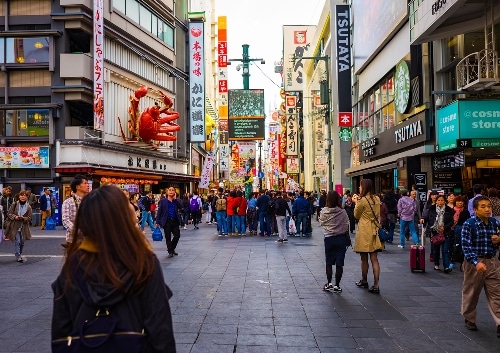
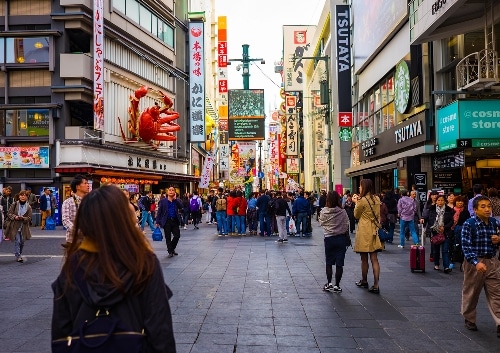
Before I traveled to Japan for the first time, I was assured by everyone that “Everybody speaks English there,” and I wouldn’t need to use Japanese at all.
But in reality, most of the people I encountered in Japan had a fairly elementary level of spoken English.
For a better travel experience, you should learn some basic travel words and phrases in Japanese.
Contents
Download:
This blog post is available as a convenient and portable PDF that you
can take anywhere.
Click here to get a copy. (Download)
Greetings and Basic Japanese Phrases

I’ll provide the hiragana, kanji and romaji for each word, and will explain the use of certain phrases in context.
1. Hello — konnichiwa
2. Good morning — ohayou gozaimasu
3. Nice to meet you — hajimemashite
4. Goodbye — sayounara
5. Please — onegaishimasu
6. Thank you — arigatou gozaimasu
7. You’re welcome — dou itashimashite
8. Excuse me/Sorry — sumimasen
This is definitely one to memorize. I say “すみません” at least 30 times a day in Japan. It’s a magical word.
It helps you push through a crowd, get attention from a waiter, ask for directions or be excused for basically any touristy blunder.
Simply saying “すみません” and gesturing is a pretty good way to express that you need help, but don’t speak Japanese.
9. Yes — hai
10. No — iie
11. Let’s Eat/ “Bon Appetit” — itadakimasu
Similar to the French “bon appetit”, this is what Japanese people say before they eat.
It doesn’t have a literal translation in English, but it’s a way to give thanks for a meal.
You should also remember this phrase’s pair: ごちそうさま (gochisousama) or ごちそうさまでした (gochisousama deshita).
These phrases are used at the end of a meal and translate as “What a good meal,” or “Thank you for the meal”, the latter being the more polite form.
12. I don’t understand — wakarimasen
13. I don’t speak Japanese — nihongo o hanashimasen
14. Do you speak English? — eigo o hanashimasu ka?
15. Can you please repeat that? — mou ichido itte kudasai
16. Can you please speak slowly? — yukkuri hanashite kudasai
17. What is your name? — onamae wa nan desu ka?
18. My name is… — watashi no namae wa…
19. How much does this cost? — kore wa ikura desu ka?
Or, if you’re pointing at something that you can’t reach, you say “それは いくらですか?”
これ and それ literally just mean “this” and “that.”
20. Can you please help me? — tasukete moraemasuka?
21. I want to go… (here) — (koko) ni ikitai desu
Say ここ if you have an address written down or a point marked on a map of where you want to go.
If you know the name or address of the place where you want to go, simply say the place name followed by に行きたいです.
For example, if you want to go to Shinjuku station, you simply say “新宿駅に行きたいです” — Shinjuku eki ni ikitai desu.
Asking for Directions

Asking for directions is sort of daunting, especially when the person answers in a whole stream of fast-paced Japanese.
But you’ll find that Japan is one of the best places to be a lost and hopeless tourist—there’s always someone nearby who’s more than happy to help. I’ve even had people take time out of their days to walk me where I needed to go!
Simply say wherever it is that you want to go followed by どこですか? — doko desu ka?.
22. Where is the…? — …wa doko desu ka?
23. Can you please show me where we are on the map? — watashitachi ga doko ni iru no ka, chizu de oshiete kudasai
This might seem like an odd question (and a bit of a mouthful), but it can be a lot more helpful than asking for directions from someone who doesn’t know English.
24. Is it near? — chikai desu ka?
25. Is it far? — tooi desu ka?
26. Take me to this address, please — kono jyuushyo made tsureteitte kudasai
27. What is the fare? — ryoukin wa ikura desu ka?
28. Stop here, please — koko de tomatte kudasai
29. Does this bus go to (street name)? — kono basu wa … ni ikimasu ka?
30. Does that train stop at ___? — sono denshya wa ___ de tomarimasu ka?
31. A map, please — chizu o onegai shimasu
32. This hotel — kono hoteru
33. The subway — chikatetsu
34. The train station — denshya no eki
35. The bus stop — basutei
36. The exit — deguchi
37. The entrance — iriguchi
38. The bathroom — toire
Receiving Directions
39. Go straight ahead — massugu itte kudasai
40. Turn left — hidari ni magatte kudasai
41. Turn right — migi ni magatte kudasai
Eating and Drinking in Japan

The best restaurants in Japan are the authentic ones that don’t cater to tourists. But these are also the places that have no English menus, and sometimes no English-speaking waitstaff.
Luckily, it’s very common for Japanese menus to feature photos of all the dishes. And many places have models of their dishes on display, so you likely won’t be going in completely blind.
Use these phrases, and you should be in and out of a restaurant without a hiccup.
42. A table for two, please — futari you no teeburu o onegai shimasu
You can also replace futari with the number of people who you need to have seated:
If you’re confused about Japanese numbers and counters, don’t despair. You can just do as the locals do and indicate the number of diners by holding up your fingers.
43. The menu, please — menyuu o onegai shimasu
44. Water, please — mizu o onegai shimasu
45. Two beers, please — beeru o nihai onegai shimasu
46. Can I please have (one, two) of this? — kore o (hitotsu, futatsu) onegai shimasu?
47. Do you have a vegetarian dish? — bejitarian youno ryouri ga arimasu ka?
I’ve traveled in Japan with vegetarians twice, and this question usually draws quite strange looks. Vegetarianism basically doesn’t exist in Japan, although Japanese cuisine is generally quite vegetarian-friendly.
It might work better to say “これは肉ですか?” — kore wa niku desu ka?, to say “is this meat?”
Follow up with “私は肉を食べません” — watashi wa niku o tabemasen, which means “I don’t eat meat,” if you want to make yourself understood.
48. That’s okay — daijyoubu desu
You can also use this expression to ask someone if they’re okay. Just add the question particle ka to the end: 大丈夫ですか ? — daijyoubu desu ka?
49. The check, please — okanjyou o onegai shimasu
Say the above, or you can do as the locals do and catch the waiter’s eye (with a smile!) and draw a clockwise circle in the air with your index finger pointing towards the roof.
In some restaurants, you need to bring the check to the cash register which usually is located by the restaurant’s doorway.
50. Cheers! — kanpai!
51. It was delicious — oishikatta desu
52. Water — mizu
53. Wine — wain
54. Beer — beeru
55. Meat — niku
56. Chicken — toriniku
57. Pork — butaniku
58. Beef — gyuuniku
59. Fish — sakana
60. Rice — gohan
61. Bread — pan
62. Vegetables — yasai
63. Fruit — kudamono
64. Tea — ochya
65. Coffee — coohii
Going Shopping

When you walk into a store or restaurant in Japan, you will be met with cries of いっらしゃいませ! (Irrashya imase!)
You aren’t expected to say anything in particular in response to this greeting, which basically means “welcome.” I just smile and say “こんにちは” which means, of course, “hello.”
Walking into a department store is particularly surreal, with each assistant taking cues from the others, so that every time a customer walks in “いらっしゃいませ!” bounces around the entire floor.
66. I would like this — kore o onegai shimasu
67. I would like one of those — sore o hitotsu onegai shimasu
68. How much does this cost? — kore wa ikura desu ka?
69. I would like to pay in cash — genkin de onegai shimasu
70. I would like to pay by credit card — kurejitto kaado de onegai shimasu
Phrases You’ll Hear When Shopping
71. Are you looking for something? — nani ka osagashi desu ka?
72. Is that all? — ijyou de yoroshii desu ka?
73. Here it is / Here you go — hai, douzo
Number of Items in Japanese
The only real challenge with ordering meals in Japanese is the use of counters.
We have counters in English, too (for example “sheets” of paper, “glasses” of water, “blades” of grass), but not so many or so complicated as in Japanese.
Luckily Japanese has a “universal” counter, つ, which you can use for anything, including food.
The numbers one to four as つ counters are pronounced 一つ、二つ、三つ 、四つ. You can use this counter for drinks too, and the waiter will understand you.
However, if you want to be a little more impressive, you can use the drinks counter: 杯 . The numbers one to four using this counter are 一杯 、二杯、三杯、四杯.
If you want to learn more about counters, this post explains them in more detail.
Notes on These Phrases: Politeness and Pronunciation
All the examples I’ve given are in the polite, neutral form of speech. You basically can’t go wrong speaking this way in Japan, so you don’t need to worry about making any social faux pas!
Some notes on pronunciation:
- Avoid turning vowels into dipthongs (vowel sounds that run into each other, like the oi in “coin”).
Pronounce each vowel on its own even when there are two vowels next to each other. Onegai is read as “o-ne-ga-i,” not “o-ne-gai”
- The sound ou and repeated vowels like ii and ee are exceptions: They show an elongation of the sound. Ohayou is read as “o-ha-yoh,” not “o-ha-yo-u.”
- Treat ん (n) as its own syllable. Konnichiwa is read “ko-n-ni-chi-wa,” not “ko-ni-chi-wa.” It’s subtle, but it makes a difference!
- Repeated consonants are pronounced. For an example of how to do this, just read the word “bookkeeper” out loud.
- The small kana っ like in いって signify a break between the sounds—”it-te,” not “i-te.”
- Small y- kana like ゃ in おちゃ add the y sound to the preceding syllable—”o-chya,” not “o-chi-a.”
- は (ha) as a particle is pronounced wa, and を (wo) as a particle is pronounced o.
We won’t get into much more than that in this post. But if you want to dive deep into the intricacies of Japanese pronunciations, we have a post for that.
How to Study These Japanese Travel Phrases
The beauty of Japanese is that it’s an extremely phonetic language, so if you say the words exactly as you read them, you can’t really get them wrong.
Having said that, people will probably struggle to understand you if you speak in a strong non-Japanese accent, so it might pay to listen to some spoken Japanese before you start practicing pronunciation.
The most important thing to remember is that, unlike English speakers, Japanese speakers don’t put emphasis on the second or third syllable of a word—there’s some emphasis on the first syllable, but it’s subtle.
Some ways that you can listen to Japanese being spoken is by watching Japanese films or television programs, anime or YouTube clips.
The Japanese language program FluentU has a little bit of everything in the media, with interactive subtitles and customizable flashcards for a well-rounded learning experience.
You can also visit Forvo and click on any phrase to hear a recorded clip of the pronunciation by a native speaker.
Maybe this seems like a lot, but it will make your trip run more smoothly, and the people you meet will appreciate your effort.
Speaking the local language tends to get people on your side. They’re less likely to try to rip you off, and often will want to become your best friend.
I like to make little phrasebooks for myself when I travel, so I can have these Japanese travel phrases and vocabulary always on hand.
I’ve been treated to tea and dinner in people’s homes, and once was driven around a city with a personal guide/impromptu friend all day, just because I struck up conversations in the local language.
Don’t be scared! Give it a try!
Download:
This blog post is available as a convenient and portable PDF that you
can take anywhere.
Click here to get a copy. (Download)


